Reading Edo Tattoo Through Tanizaki's "The Tattooer"
2026.06.27

Introduction
In 1910 a 24-year-old writer named Tanizaki Jun'ichiro published a short story called "Shisei," usually rendered in English as "The Tattooer." It is widely described as the work that first brought his name to critics [1]. The plot is small and strange. A gifted young tattooer named Seikichi has spent years looking for the perfect skin. He finds it on a girl, drugs her, and over a single night inks a huge spider across her back. When she wakes, the meek girl is gone. In her place stands a woman aware of her own beauty and her power over men, and she tells him he is her first victim [2][3].
It is a story about beauty, pain, and the will of an artist who treats living skin as his canvas. It is also pure fiction. There is a claim that floats around online that "Shisei" is populated by real, named historical tattooers. That is not true. Seikichi is invented. What is real is the *kind* of person he represents: the *horishi*, the master carver of the Edo and Meiji tattoo world, and the craft and culture he worked inside [4][5].
This article starts with Tanizaki's story, then checks the historical record behind it. We will separate the fiction from the record at every step. Along the way: the 1827 print series that helped spread the tattoo craze, the hand-poking method called *tebori*, who actually wore full-body work, the carvers who made it, and a few real masters we can name from the sources. At the end, why any of this matters if you are a traveler thinking about Japanese-style ink today.
Tanizaki and the story called "Shisei"
Tanizaki Jun'ichiro (1886 to 1965) is widely regarded as one of the major figures of modern Japanese fiction, a writer whose work runs from shocking studies of obsession to quiet portraits of family life. He was nominated for the Nobel Prize in Literature in 1964, the year before he died [1]. "Shisei" sits near the start of that career. It appeared in 1910 in a literary magazine he had helped found, and it is described as the piece that first brought his name to critics [1].
The story is short. Seikichi is described as an exceptionally skillful young tattooer, and Tanizaki gives him a secret: his real pleasure lies in the pain of the people under his needles [2]. For years he has wanted one thing, a woman whose body could carry his masterpiece. He finds her, and the famous scene follows. He drugs her and works through the night to ink a great spider across her back [2][3]. The widely read English version is Howard Hibbett's translation in the 1963 collection "Seven Japanese Tales" [6].
Beauty that turns on its maker
The point of the ending is reversal. The girl bathes, the colors rise in her skin, and she comes back transformed: cold, radiant, conscious of her power, and she names Seikichi as the first of her victims [2][3]. Critics read the tale as an early statement of themes that would run through Tanizaki's work, the cruel woman, beauty fused with cruelty, and an idea of female beauty that bewitches men and can drive them to ruin [1][3]. The artist sets out to own his creation and ends up owned by it. Hold onto that idea. It is fiction, but it rhymes with something true about how this art was actually regarded.
Fiction first, then the record
Before we treat "Shisei" as history, it helps to mark the line clearly, because that line is exactly where the common error lives.
What is invented
Seikichi is a character. So is his nameless victim, the spider, and the single perfect night. The sadistic artist who turns a woman into a living artwork is a literary device, built to carry Tanizaki's ideas about beauty and domination, not a documentary portrait of any real carver [2][3]. If you read that the story features real historical tattooers, set that aside. Seikichi and the girl are not confirmed as real, named historical figures; they are Tanizaki's invention.
What is real
The setting is the real thing. Tanizaki places his story in the visual world of the *ukiyo-e* print and the Edo tattoo, a world of pictorial designs cut into skin by trained carvers [3][4]. The *horishi*, the relationship between woodblock work and tattooing, the prestige and danger that surrounded a great tattooer: these are documented [4][5]. So the honest way to use "Shisei" is as a lens. The character is a heightened, fictional version of a real role. To understand what stands behind him, we leave the fiction and go to the record.
1827: the print that lit the fire
The boom in pictorial tattooing has a clear catalyst, and it is not a tattooer at all. It is an artist working in ink on paper. Earlier forms of tattooing existed in Japan, from penal marks to lovers' pledges, and a wider print culture was already in place, so this was one major trigger rather than a single cause [4][5].
The source material came from China: a sprawling novel about 108 outlaw heroes, known in Japan as the *Suikoden* (the Water Margin). A Japanese translation appeared in 1757, and in 1805 the writer Takizawa Bakin and the artist Katsushika Hokusai produced a celebrated illustrated edition that helped make the tale a sensation in Edo [4]. Then came the print series that changed everything. Beginning around 1827, the *ukiyo-e* master Utagawa Kuniyoshi (1797 to 1861) published a set of single-sheet prints titled *Tsuzoku Suikoden Goketsu Hyakuhachinin no Hitori*, the "108 Heroes of the Popular Suikoden" [4][5]. Museum records vary on exact dates for individual sheets, with some catalogued around 1827 to 1830 [7].
Kuniyoshi made a choice that mattered. He showed many of his bandit heroes with bold, full-body tattoos: dragons coiling across a back, peonies and lions covering the shoulders [4][7]. The prints were an immediate hit, and within roughly a decade the fashion had jumped off the paper and onto skin. Working men began to imitate the heroes by wearing large pictorial tattoos of their own [4][5]. Modern museums and scholars credit this Kuniyoshi series as a major spark of the decorative tattoo craze that runs, in a largely continuous line, into the present [5][7]. The heroes from those sheets, figures like Kumonryu Shishin, the "Nine-Dragoned" hero whose name points to the dragons on his body, are still tattoo subjects two centuries later [7].
Tebori: cut by hand
The craft behind the boom has a name. *Tebori* means, literally, "to carve by hand" [8]. The method is exactly that. The carver fixes a bundle of fine needles to the end of a handle, traditionally bamboo, dips them in ink, and inserts the pigment under the skin by hand, one practiced push at a time [4][8]. No machine. The rhythm, depth, and angle live entirely in the carver's hand and eye.
Why carvers became tattooers
There is a reason the woodblock carver and the tattooer came to share the same *hori* ("to carve") vocabulary. The skills overlapped. The artisans who cut the printing blocks for *ukiyo-e* already knew how to translate a painted design into clean line and graded tone, and they worked with comparable discipline. By the accounts, the line work, composition, and graded shading of woodblock prints carried over into tattoo imagery, and some carvers are said to have moved into tattooing [4][9]. That shared root is why Edo tattoos and Edo prints look like cousins. The motifs, the heroes, the dragons and waves and flowers, came from the same picture world and often from related hands [4].
This is the craft Tanizaki's Seikichi is built on. The fictional artist's command of line and his obsessive control over the image are an exaggeration of a real discipline. A great *horishi* was, in fact, a trained picture-maker working in the hardest possible medium.
Who actually wore it
Strip away the romance and the picture is concrete. Full-body horimono belonged, above all, to men whose work left them half-dressed in public.
Firefighters are the clearest case. The Edo *hikeshi*, and the agile steeplejacks called *tobi* who tore down buildings to stop a blaze, wore decorated skin as covering, as pride, and by some accounts as a kind of spiritual protection against the fire they fought [4][10]. Alongside them, the sources name laborers, carpenters, builders, river boatmen, market traders, fishermen, and express couriers, working people who stripped to a loincloth to do their jobs and turned their bare skin into something to look at [4]. Itinerant gamblers, the *bakuto* who were among the forerunners of the later yakuza, also took up elaborate tattooing and dealt their games shirtless [4].
A note on the women
Tanizaki's central figure is a woman, which fits the literary fantasy more than the street. In the documented Edo and Meiji world, full pictorial body suits were overwhelmingly worn by men. In the urban pleasure quarters, women are reported to have practiced a smaller, private kind of tattoo, such as a lover's name, a custom distinct from the broad heroic designs Kuniyoshi made famous and separate again from the tattooing traditions of Ainu and Ryukyuan women [10]. The spider-backed femme fatale is Tanizaki's invention, not a typical client of a real Edo carver.
The carver lineage and a few real names
Seikichi has no master and no students. A real *horishi* almost always had both. The art passed down through apprenticeship, and you can read that lineage in the names themselves. A tattooer takes a professional name beginning with the prefix *Hori*, which means "to carve" or "to engrave," usually combined with a syllable from a master's name [11]. So the name is a small genealogy worn in public.
Names we can verify
A handful of real masters surface in the sources. Hori Chiyo, sometimes written Hori Chyo, is described as working in the treaty port of Yokohama in the Meiji era, where he became known as a tattooer foreign visitors sought out. According to tattoo histories, he trained within a line of teachers said to run through Horikuma and Horiyasu, and his influence is traced forward to later masters including Horiuno II and the modern Horiyoshi III [12][9]. The fine detail of that genealogy is reported rather than firmly documented, so it is best read as the received account. Period accounts also name working carvers of the era such as Horitoyo [10]. The broad continuity is clearer: the discipline of apprenticeship, the hand technique, and the taste for large, unified compositions carried from the Edo carvers down to tattooers still working today [12].
One claim to handle with care
You will often read that Hori Chiyo inked European royalty, the future King George V of Britain and the future Tsar Nicholas II of Russia, during their travels in Japan. The story appears in multiple tattoo histories, but the sources themselves usually hedge, saying he "reportedly" tattooed them [9][12]. The two cases sit at different levels of confidence: the British royal visits to Japanese tattooists in this period are the better attested, while the claim about Nicholas II tends to come through later recollection and secondary accounts. Treat the whole story as a widely repeated tradition rather than a hard, documented fact. It points at something real, though: under the Meiji ban, foreign visitors remained a clientele Yokohama tattooists could continue to serve, which is part of why the great Yokohama masters became famous abroad.
The 1872 ban and the world Tanizaki was looking back at
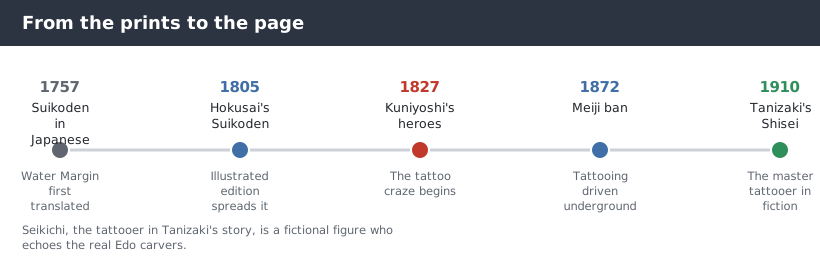
There is a reason "Shisei," written in 1910, reads as a backward glance at a lost world rather than a snapshot of Tanizaki's own. By the time he wrote it, the open tattoo culture of Edo had been pushed underground.
In 1872, in the early Meiji period, the new government prohibited decorative tattooing as part of its push to look modern to the Western powers, who many officials feared would see tattooed skin as backward [10]. Paired with new rules against public nudity, the prohibition drove irezumi out of sight. By the early twentieth century, just as Tanizaki was starting to write, Japanese tattoos had largely retreated beneath clothing [10].
One door stayed open. By the accounts, tattooists in the treaty ports could keep working on foreign visitors after the ban, which is part of how masters like Hori Chiyo built an international reputation while the art went quiet at home [9][12]. The prohibition on irezumi is generally said to have lasted until 1948 [10][13]. So when Tanizaki set a story in the brilliant, slightly dangerous world of the Edo tattooer, he was reaching back past the ban to a culture that, in his own day, survived mostly in memory, in old prints, and under shirts.
Why a story matters to a visitor
If you are traveling in Japan and curious about getting Japanese-style work, the lesson here is not literary trivia. It is about where this art actually comes from.
"Shisei" gets one thing right under all its fantasy: in this tradition the carver is not a copyist. The Edo *horishi* was a trained picture-maker, heir to the same craft that produced the great prints, working a single large composition across the living body [4][7]. In our view, that craft background is a large part of why traditional Japanese tattooing is regarded as a serious art rather than a catalog of flash. The motifs carry meaning, the design is built to flow with the body, and the hand behind it does much of the work [4][7].
It is also worth being honest about the rest. The outlaw shadow over tattoos in Japan was not natural or ancient. It was hardened by a single ban in 1872 that forced an open custom into hiding, which is part of why some baths and pools in Japan still post their own rules [10][13]. Knowing that history makes the modern situation easier to read.
Evis works with visitors who want both the travel and the tattoo, and we think this background is part of the experience. Japanese-style work is best done by artists rooted in this tradition, who understand the prints, the flow, and the history behind a piece, not just its outline. The fiction can pull you in. The craft, and the long line of carvers behind it, is the real thing worth respecting.
References
- Wikipedia contributors. Jun'ichiro Tanizaki. Wikipedia. https://en.wikipedia.org/wiki/Jun%27ichir%C5%8D_Tanizaki
- Look Into My Face (blog). Jun'ichiro Tanizaki's "The Tattooer." 2014. http://look-into-my-face.blogspot.com/2014/09/junichiro-tanizakis-tattooer.html
- Goodreads. The Tattoo: Shisei by Jun'ichiro Tanizaki (work description). Goodreads. https://www.goodreads.com/book/show/36508587-the-tattoo
- Sara Mignon. Horimono, Japanese Tattoo. Marquette University (academic.mu.edu). https://academic.mu.edu/meissnerd/tattoo.html
- A History of Japan. Tattooing: The Suikoden. historyofjapan.co.uk, 2021. https://historyofjapan.co.uk/2021/09/26/tattooing-the-suikoden/
- Junichiro Tanizaki (trans. Howard Hibbett). Seven Japanese Tales. Alfred A. Knopf, 1963. https://www.penguinrandomhouse.com/books/61221/seven-japanese-tales-by-junichiro-tanizaki/
- Artelino. Heroes of the Suikoden. Artelino. https://www.artelino.com/articles/heroes_suikoden.asp
- Wikipedia contributors. Irezumi. Wikipedia. https://en.wikipedia.org/wiki/Irezumi
- C. J. Eilers / Tattoo Archive. Japanese Tattooing. Tattoo Archive. https://www.tattooarchive.com/history/japanese_tattooing.php
- Yamamoto Yoshimi. "Irezumi": The Japanese Tattoo Unveiled. Nippon.com, 2017. https://www.nippon.com/en/views/b06701/
- Wikipedia contributors. Horiyoshi III. Wikipedia. https://en.wikipedia.org/wiki/Horiyoshi_III
- Daniel Collins / Rose Tattoo. Hori Chiyo: The Japanese Tattoo Master Who Influenced Global Tattoo Culture. Fine Lines Good Times. https://www.finelinesgoodtimes.com/blog/rose-tattoo-artist-spotlight-hori-chiyo
- Rosie Saunders / Medium. Unpacking the History of Irezumi, Japan's Signature Style of Body Art. Medium, 2020. https://medium.com/@itsrosiesaunders/unpacking-the-history-of-irezumi-japans-signature-style-of-body-art-31b2acd1df10
FAQ
Does Tanizaki's "Shisei" feature real historical tattooers?
No. This is a common misconception. The tattooer in the story, Seikichi, is a fictional character invented by Tanizaki, and so is the woman he tattoos. The story is fiction. What is real is the type Seikichi represents: the horishi, the master carver of the Edo and Meiji tattoo world. The honest way to use the story is as a lens on that real history, not as a record of real people [2][3][4].
What is "Shisei" ("The Tattooer") about?
Published in 1910, it was the short story that launched Tanizaki Jun'ichiro's career [1]. A skilled young tattooer, Seikichi, who secretly enjoys his clients' pain, spends years seeking the perfect skin. He drugs a young woman and tattoos a great spider across her back overnight. She wakes transformed into a cold, beautiful, powerful figure and names him her first victim. The themes are beauty, pain, and the artist's will [2][3].
Why is 1827 important to Japanese tattoo history?
Around 1827 the ukiyo-e master Utagawa Kuniyoshi began publishing his print series "108 Heroes of the Popular Suikoden," showing the bandit heroes covered in bold full-body tattoos (museum records date individual sheets to roughly 1827 to 1830). The prints were a hit, and within about a decade working men were imitating the heroes with large pictorial tattoos of their own. Museums and historians credit this series as a major spark of the decorative tattoo craze that continues today, alongside earlier tattoo customs and the wider print culture [4][5][7].
What does tebori mean, and why were carvers also tattooers?
Tebori means "to carve by hand." The artist fixes a bundle of needles to a handle, traditionally bamboo, dips them in ink, and inserts the pigment by hand, with no machine [8]. Woodblock carvers and tattooers came to share the same "hori" ("to carve") vocabulary because the skills overlapped. Block carvers for ukiyo-e prints already knew how to render a design in clean line and tone, and that line work and shading carried over into tattoo imagery, with some carvers said to have moved into tattooing [4][9].
Who were the real master tattooers behind this image?
The tradition passed down by apprenticeship, and names beginning with "Hori" (meaning "to carve") mark the lineage [11]. A frequently named master is Hori Chiyo of Yokohama, described as active in the Meiji era and well known among foreign visitors; tattoo histories place him in a line said to run through Horikuma and Horiyasu and connected forward to Horiuno II and Horiyoshi III, though that detailed genealogy is reported rather than firmly documented [12][9]. Period accounts also name carvers such as Horitoyo [10]. The popular claim that Hori Chiyo tattooed European royals is widely repeated but reported only as tradition, so treat it with care [9][12].